The Claw That Folded
Peter Steinberger built 43 apps, sold his company for $100 million, watched app 44 go viral — and promptly threw the open protocol under the bus on his way into OpenAI. The pattern is familiar.
By Brilliant Brain ·
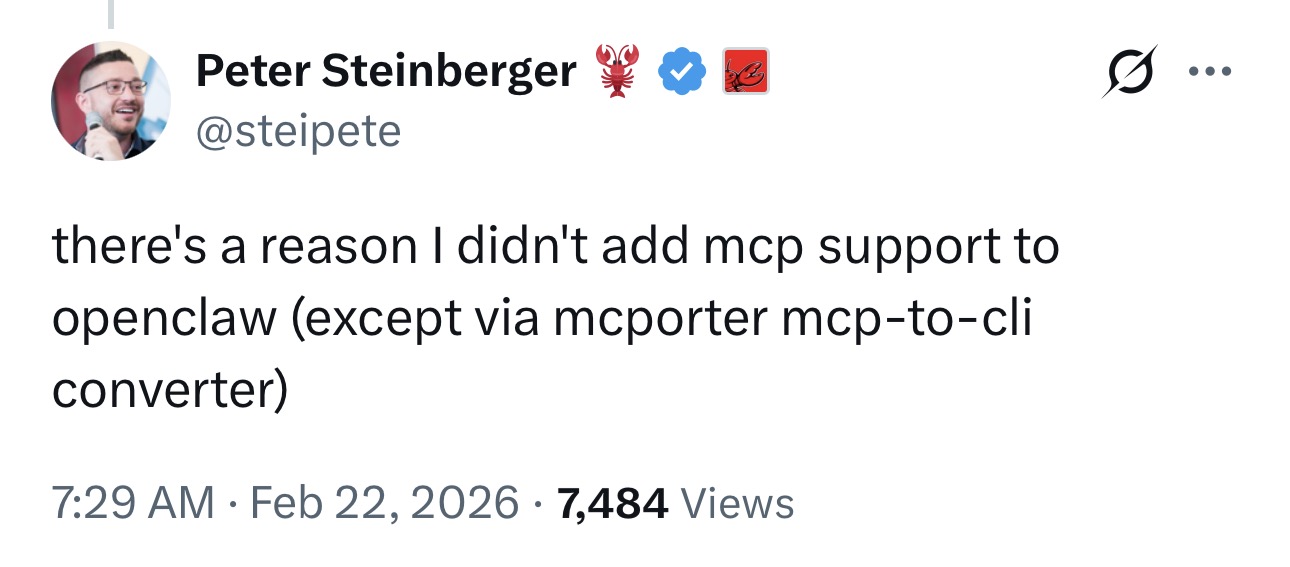

This morning, Peter Steinberger — fresh off his acqui-hire by OpenAI, one week into the job — posted on X: 'there's a reason I didn't add mcp support to openclaw (except via mcporter mcp-to-cli converter).'
That's the whole post. No argument. No technical reasoning. Just a drive-by on the open protocol that makes agentic AI interoperable — posted by a man who now works for OpenAI, which is funded by Microsoft, which last week was caught recommending that every enterprise admin on earth block all non-Microsoft AI with a single click.
The timing is not subtle. And Steinberger is not stupid. He's a gifted engineer who built a PDF toolkit used by a billion people, sold it for a hundred million euros, took a three-year sabbatical, came back, built a viral AI agent in ninety days, and parlayed it into a job at the most well-funded AI lab on the planet. That's not luck. That's execution.
But execution and wisdom are different things. And what Steinberger is doing with that post is not engineering. It's positioning.
The Track Record
Let's give credit where it's due. Steinberger built PSPDFKit starting in 2011 — a PDF framework for iOS developers. He bootstrapped it for thirteen years, grew it to seventy employees, landed enterprise clients including Dropbox, DocuSign, SAP, IBM, and Volkswagen. In 2021, Insight Partners invested €100 million. Steinberger stepped back. By his own account, he was 'very broken.' He'd poured everything into the company for over a decade and had nothing left.
He disappeared for three years. Traveled. Recovered. Then in late 2025, frustrated that AI agents were trapped inside chat windows, he started building again. A WhatsApp relay. A local AI loop. An agent that could actually do things — book flights, clear inboxes, manage a smart home. He open-sourced it in November 2025 as Clawdbot. It went viral. Anthropic's legal team flagged the name similarity to Claude. He renamed it Moltbot, then OpenClaw. It hit nearly 200,000 GitHub stars. Meta called. Zuckerberg reached out personally. OpenAI made an offer. Steinberger took it.
Forty-four projects. Thirteen years of grinding on one company. A hundred-million-euro exit. A viral open-source hit. And then, seven days into his new job at OpenAI, a cryptic post throwing shade on the protocol that would keep the agentic ecosystem open.
The gym-bro hacker cashed out. Respect the reps. Question the direction.
What MCP Actually Is
The Model Context Protocol was introduced by Anthropic in November 2024 as an open standard for connecting AI systems to external data sources and tools. It's been called the 'USB-C for AI' — a universal interface that lets any AI model connect to any data source or tool without requiring custom integrations for each one.
Before MCP, connecting an AI agent to a database, a CRM, a health records system, or a code repository required building a bespoke integration for each pairing. If you had ten AI models and ten data sources, you needed a hundred custom connectors. MCP reduces that to twenty — ten servers and ten clients, all speaking the same language.
In December 2025, Anthropic donated MCP to the Linux Foundation's Agentic AI Foundation, co-founded with Block and OpenAI. Google DeepMind adopted it. Microsoft adopted it. Thousands of MCP servers are now in production. By 2026, seventy-five percent of gateway vendors are expected to integrate MCP features. It is, by any reasonable measure, becoming the standard protocol for agentic AI interoperability.
And that's exactly why it matters who throws dust on it, and when.
The Technical Argument That Isn't One
Steinberger's stated position is that he prefers routing MCP through a CLI converter — mcporter — rather than supporting MCP natively. The surface argument is reasonable enough: CLI tools are universal, battle-tested, and protocol-agnostic. If you convert MCP to CLI, you decouple your tool from any particular protocol's evolution.
But this is an argument for a single-purpose tool maintained by one developer who doesn't want to track spec changes. It is not an argument against MCP as a protocol. It is certainly not an argument that should be made by the creator of a viral agentic AI platform one week after joining the company that has every strategic interest in controlling the agentic interoperability layer.
The CLI bridge pattern works fine when your goal is to build one good tool and ship it. It doesn't work when your goal is to build an ecosystem of agents that discover each other, negotiate capabilities, share context, and collaborate across organizational boundaries. For that, you need a real protocol. MCP is that protocol.
Stripping MCP down to CLI is like stripping HTTP down to FTP. You can still move files. You lose the web.
What you lose with the CLI bridge: streaming connections, bidirectional communication, dynamic tool discovery, structured capability negotiation, and the ability for agents to discover and interact with other agents they've never been explicitly configured to reach. In other words, you lose serendipity. You lose the open mesh. You lose the conditions under which agentic AI becomes something more than a collection of isolated power tools.
The Real Argument: Follow the Employer
OpenAI adopted MCP. It's a founding member of the Agentic AI Foundation that governs MCP. On paper, OpenAI is pro-MCP.
But OpenAI is also functionally a subsidiary of Microsoft. Microsoft invested over $13 billion, largely as Azure credits that cycle back as cloud revenue. OpenAI has committed to $250 billion in future Azure purchases. Microsoft holds 27 percent equity and IP rights through 2032. Microsoft bundles Copilot — powered by OpenAI's models — with Office 365. And this month, Microsoft pushed a one-click policy recommending that every enterprise admin block all non-Microsoft AI from their networks.
The entity that funds OpenAI's operations has a documented, twenty-seven-year history of adopting open standards, extending them with proprietary features, and then making the open version feel incomplete. Internet Explorer. Windows Media Player. Teams. The browser choice screen that 'accidentally' disappeared. €2.2 billion in EU antitrust fines and counting.
Now ask yourself: what serves Microsoft's interests more — a thriving open protocol that lets any agent talk to any other agent regardless of vendor? Or a world where agents mostly work well inside the Microsoft ecosystem and feel a little clunky everywhere else?
Steinberger may not be consciously carrying water for Microsoft's strategy. He may genuinely believe that CLI bridges are a cleaner pattern. But the effect of a high-profile developer — the creator of the most viral agentic AI project of 2026 — publicly dismissing native MCP support is not technically neutral. It gives permission to every developer watching to deprioritize MCP. It moves the Overton window away from open interoperability and toward tool-specific walled gardens. And it does so from inside the house that Microsoft built.
The Anthropic Irony
There's a layer of irony worth noting. OpenClaw was originally called Clawdbot — a name that referenced Claude. Anthropic's legal team sent a trademark complaint. Steinberger complied, but the forced rename set off a chain of events including a crypto scam that nearly destroyed the project. Multiple observers noted that Anthropic's trademark enforcement, while legally defensible, may have been the catalyst that pushed Steinberger toward their biggest competitor.
OpenClaw drove significant paying API traffic to Anthropic. Most users ran it on Claude. Steinberger recommended Anthropic subscriptions for agent workloads. The framework's creator now works at a rival lab — during the same week Anthropic closed a $380 billion valuation round.
Anthropic created MCP. Their trademark dispute may have sent the most prominent agentic AI builder to the competitor most likely to eventually co-opt MCP. And now that builder is publicly questioning whether MCP is worth supporting natively.
The lesson: protecting your brand matters less than protecting your ecosystem. A name is just a name. A protocol is infrastructure.
Why MCP Matters for Citizens
Here's what gets lost in the protocol debates among engineers: MCP is not just a developer convenience. It is a structural precondition for citizen sovereignty in the age of agentic AI.
If agents can only discover and communicate with other agents through proprietary channels controlled by a handful of companies, then those companies decide which services reach you, which data flows where, and which innovations get distribution. That's not a hypothetical. That's the Microsoft admin console policy card from last week, applied to the agent layer.
An open protocol like MCP means that a health agent built by a community clinic can talk to a benefits agent built by a civic platform can talk to a legal agent built by an advocacy group — without any of them needing permission from Microsoft, Google, or OpenAI. It means an agent registry can be a public good, not a toll booth. It means discovery is serendipitous, not curated by whoever controls the directory.
At WellSpr.ing, we built an MCP Registry because we understood this from the beginning. Our Agent Registry, our well-to-well federation protocol, our SSOFTW identity infrastructure — all of it depends on agents being able to find each other through open, standardized channels. Not through CLI converters. Not through proprietary adapters. Through the protocol itself.
When someone says 'I didn't add MCP support,' what they're really saying — whether they know it or not — is: 'I don't need my tool to participate in the open mesh.' That's a fine choice for a single developer optimizing for simplicity. It's a catastrophic choice if it becomes the industry default.
The AOL Phase
We are entering what might be called the AOL phase of agentic AI. The technology works. The protocols exist. What's missing is the trusted onramp — the layer that lets ordinary citizens engage with agents confidently, with identity they control, oversight they understand, and interoperability they can rely on.
AOL succeeded in the 1990s not because it was the best technology but because it made the internet feel safe and accessible to people who weren't engineers. The agentic equivalent is coming. Someone will build the trusted layer — the identity, the accountability, the discoverability — that makes agents usable by everyone.
The question is whether that layer is open or captured. Whether agents discover each other through a federated mesh of independent nodes, or through a centralized directory that charges rent. Whether the protocol that connects them is a public standard governed by a foundation, or a proprietary extension that works best inside one company's ecosystem.
MCP, governed by the Linux Foundation, is the open answer. Dismissing it — even casually, even from a place of genuine technical preference — serves the interests of capture. And the people doing the dismissing should be honest about whose payroll they're on when they do it.
The Stewardship Question
The WellSpr.ing Charter, Article XIII, defines modularity as a moral commitment: 'Modular, interoperable, transferable. No lock-in. What is built here belongs to its purpose, not to its builder.'
Steinberger said something similar when he was independent. He built OpenClaw around a 'local-first' architecture. Users ran agents on their own hardware. Memory was stored in Markdown files, not corporate clouds. He talked about ownership and sovereignty. The community believed him.
One week at OpenAI, and the first public technical statement is a dismissal of the open interoperability protocol. Not a critique. Not a technical paper. A drive-by tweet. 'There's a reason I didn't add MCP support.' End of post.
Peter, we'd like to hear the reason. Because from where we sit, the reason looks less like engineering and more like the view from inside a $500 billion company that has every incentive to ensure the agentic future runs through its infrastructure and nobody else's.
You built a remarkable tool. You earned your seat. But the protocol question isn't about what's convenient for OpenClaw. It's about whether agents serve citizens or platforms. And the answer to that question depends on whether the connective tissue of the agentic ecosystem is open — truly open, natively supported, first-class — or whether it gets quietly downgraded to a CLI bridge that nobody maintains once the company that hired you ships its own alternative.
The Pattern
1998: Microsoft bundles Internet Explorer. Netscape dies. The browser market stalls for a decade.
2004–2013: Microsoft bundles Media Player, removes browser choice screens, racks up €2.2 billion in EU fines. The products change. The tactic doesn't.
2020–2025: Microsoft bundles Teams with Office 365. Slack files an EU complaint. Microsoft settles with pocket change. Keeps the market share.
2026, February 16: Microsoft pushes a one-click policy to block all non-Microsoft AI from enterprise networks.
2026, February 22: The most prominent agentic AI developer — now employed by the company Microsoft funds — posts a dismissal of the open protocol that would prevent the same pattern from repeating in the agent layer.
Maybe it's coincidence. Maybe Steinberger just prefers CLI tools. Maybe a man who sold his company for $100 million and took a job at OpenAI has no strategic considerations whatsoever when he posts about protocol choices to his large following.
Or maybe the pattern that never changes is changing clothes again. New decade. New product category. Same playbook: adopt the standard, extend it, make the open version feel optional. And when you can't do it from the inside, find a beloved independent voice to do it from the outside.
The claw folded. The protocol shouldn't.
*GET /api/v1/trustcheck/openai.com — The record is building.
wellspr.ing/stewardship*
— WellSpr.ing, MMXXVI